What the hell is SEO, AEO, GEO, AIO?
SEO, AEO, GEO… what the hell is all this? Do marketers just love inventing acronyms?
Kind of. But this time there’s a reason.
A quarter of Americans now use AI every day, up from 19% a year ago (Menlo Ventures). So the search for the perfect sweater, the best plumber in town or the app that lets you fire your whole dev team doesn’t just happen on Google anymore.
The goal is still the same: get found by people who are ready to buy. If ChatGPT recommends your competitor, you’ll never even know you lost the sale.
Let me explain what this alphabet soup means, how to show up wherever your customers search and, most importantly, how to turn that into revenue.
SEO (Search Engine Optimization)
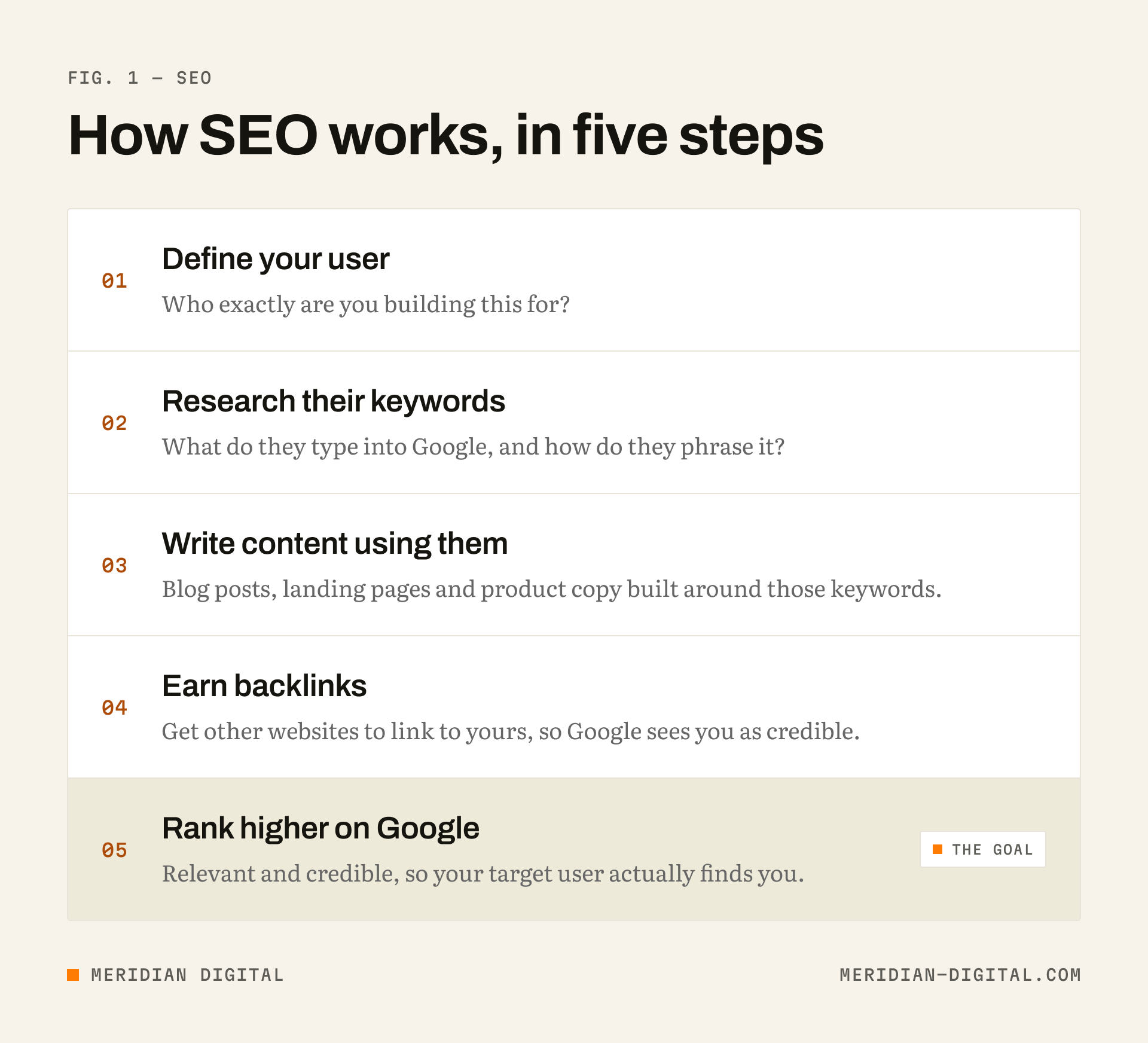
TL;DR: SEO is how you get your website to show up on Google. It comes down to two things:
- On your site: use the words your target user actually searches for (keywords).
- Off your site: get other websites to link to you (backlinks), so Google sees you as credible.
This is the OG term for making your website visible on Google Search (and others, but we all know the search bar as Google).
Google takes in, processes and memorizes the blogs, keywords and text on your website. So if the user searches for “Best tacos in town” and you put those keywords on your website (even though we all know it’s a self-assigned title ;)), you’ll pop up!
But how do we know what to put on there? First, define exactly who you’re building the website for: an average Joe with a love for tacos, a single mom in need of a babysitter, or an IT specialist who needs to integrate Copilot into all aspects of his life. Once you have that, you’ll know what they search for and in what way. Those are your keywords (you can use this tool to research them). Then write content on your site that mentions them.
Next, get your links onto as many other websites as possible. Think of them as reviews: if other pages link to you, Google will think you are a credible source and lead more people to your site (here is a list of good backlinking sites to get traction).
The aim: rank as high as possible by mentioning the keywords your users search for, and by being mentioned on other sites as a credible source.
AEO (Answer Engine Optimization)
TL;DR: AEO is how you get your site shown as the direct answer at the top of Google. It comes down to two things:
- On your page: answer questions directly, in a clear Q&A format, with no fluff.
- In your code: add schema markup, so crawlers know exactly what your answers are.
This is a relatively new thing that Google has been pushing. We’ve all seen the small box at the top of Google that gives us a straight answer with sources linked. Well, that’s what AEO targets. To get your site, blog or product mentioned there:
- use a clear Q&A format
- remove fluff from your blogs, FAQs and other text on your site
- put answers to questions directly at the top
But text alone is not enough. AEO relies heavily on schema markup: JSON code in your pages that follows a specific format crawlers love to index. To see how your favorite websites handle it, paste their URL into this tool. Use it to research competitors, see what they put in and copy it, but make sure you fill it with your data.
GEO (Generative Engine Optimization)
TL;DR: GEO is how you get AI tools like ChatGPT, Perplexity and Claude to mention your brand. It comes down to two things:
- What you target: long, specific questions your user types into AI chats, not generic keywords.
- How you write: fresh, clearly structured content in self-contained sections that AI can quote.
This is SEO’s younger and cooler brother, still in high school but starting to become the next big thing. The parents are really proud of him, and SEO is kinda sulking because of it. GEO is the practice of optimizing the content on your website to make it easier for tools like ChatGPT, Perplexity and Claude to mention you and your product.
This move from ranking high on the search page to getting quoted in AI chats is the reason people say SEO is dead. But in practice… those two things are basically the same. You still aim to hit keywords, but instead of just 1–2 words, you aim for the long queries that your target user will type into AI chats. So instead of having “Best tacos” in all your headings, you’ll have “Best tacos in New York City under $5”, so you get mentioned by AI when a person types that exact question in.
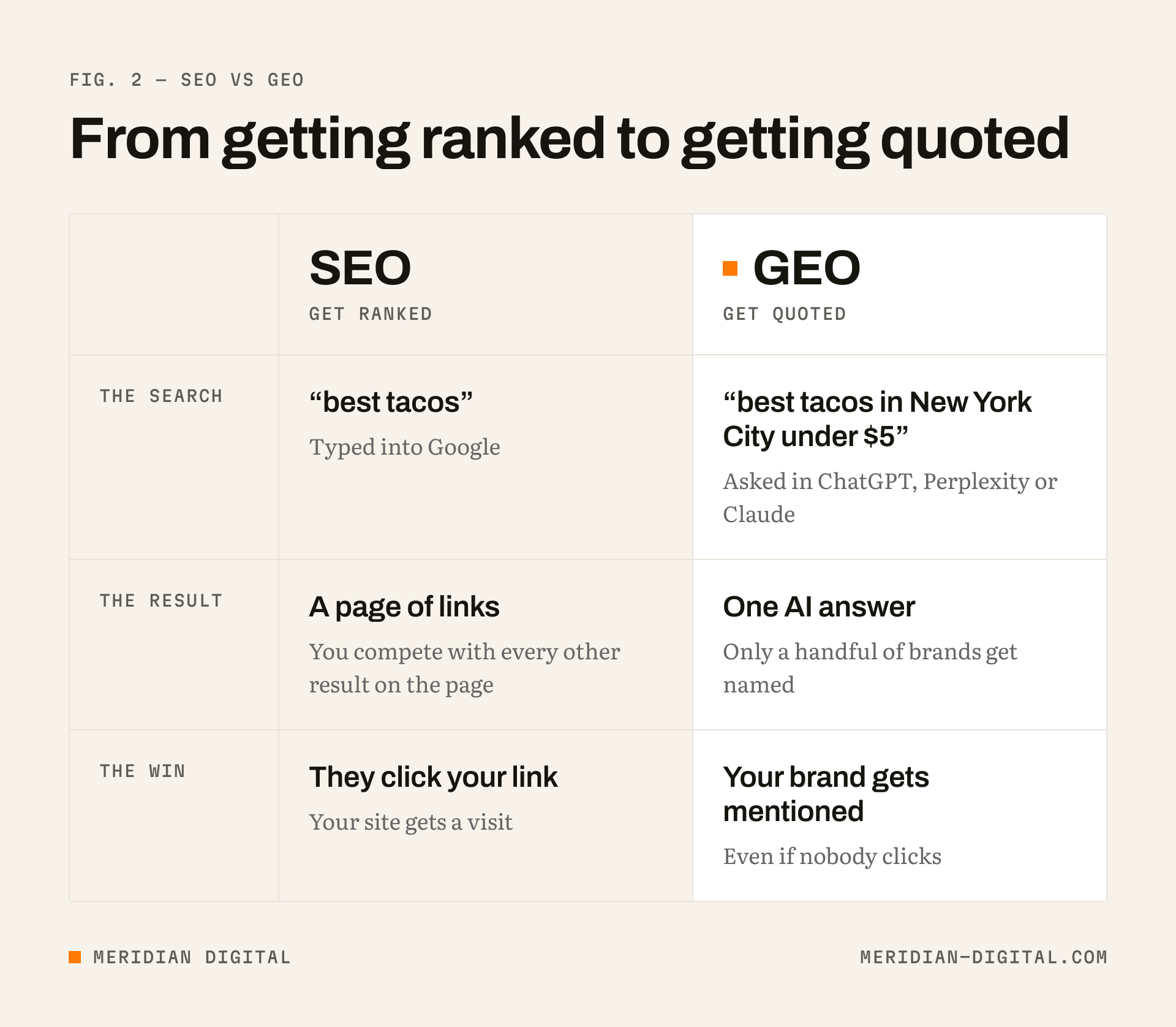
The goal is not to aimlessly chase the most generic keyword, because everyone is doing that, but to find a specific niche you fit into. That will attract more users, because the competition is far smaller. And while you increase your GEO presence, you’ll also inevitably improve your SEO.
Other than finding the list of targeted long queries, you also have to post new content regularly. That lets the AI know your knowledge is up to date and you’re truly working on your product, while giving you more and more chances to hit that list of queries across more pages. Moreover, that content shouldn’t just be cheap AI output, a swarm of words on a page or a wall of 100 sentences. AI prefers easy-to-read, structured content, chunked into sections that can be understood independently. Unlike humans, AI doesn’t read a post as one big idea. It reads section by section, finds the answer it needs and dismisses the rest. That is why independent, clearly structured content is a must.
Unlike the previous two terms, your goal here is not to get the user to click on your link per se, but to make your brand/product visible on AI’s radar.
AIO (AI Optimization)
Even though this term is used interchangeably with GEO, it doesn’t focus on the same aspects. AIO focuses on how AI processes your data. AI optimization focuses on ensuring that AI tools know your business exists and understand your product, so they know in which cases they can recommend you.
It mostly depends on structured data, the already mentioned schema markup and detailed content, unlike GEO, which focuses on textual content like blogs and other content of that kind.
Conclusion
I’ve just listed four different things, but… all in all… once you start focusing on one, you’ll improve all of them:
- SEO is the foundation: it gets you found on Google.
- AEO gets you featured in quick answers.
- GEO gets AI to mention you.
- AIO makes sure AI understands you.
The world of “showing up online” is simpler than all these acronyms make it look. They all use the same content over and over for a different goal, be that the headings on your page or your schema markup. If you find a blueprint you can follow over and over, you’ll be able to reproduce your success on every website you create.
Because remember: if ChatGPT recommends your competitor, you’ll never even know you lost the sale.
You can build your own templates and huge Excel files to track all of this, but if you don’t have the time, there are a lot of tools online that can help you do the job faster and easier. We’ve built one such tool ourselves: Citedom. Run a free analysis to see how your website shows up in AI, and if you want to go further, upgrade to get our recommendations on how to improve it and get cited.